In the expansive grasslands of Inner Mongolia, farmers are picking plump potatoes alongside new neighbours: huge, rectangular blocks that will fuel China's AI platforms.
In the expansive grasslands of Inner Mongolia, farmers are picking plump potatoes alongside new neighbours: huge, rectangular blocks that will fuel China's AI platforms.
Ulanqab, with its steppes and volcanoes, is an unlikely digital frontier. For years, it has been China's official "potato capital". But now its fields have also become construction sites for a slew of data centres, as Donald Trump and his Chinese counterpart Xi Jinping meet to discuss AI safety among other things.
Ulanqab, with its steppes and volcanoes, is an unlikely digital frontier. For years, it has been China's official "potato capital". But now its fields have also become construction sites for a slew of data centres, as Donald Trump and his Chinese counterpart Xi Jinping meet to discuss AI safety among other things.
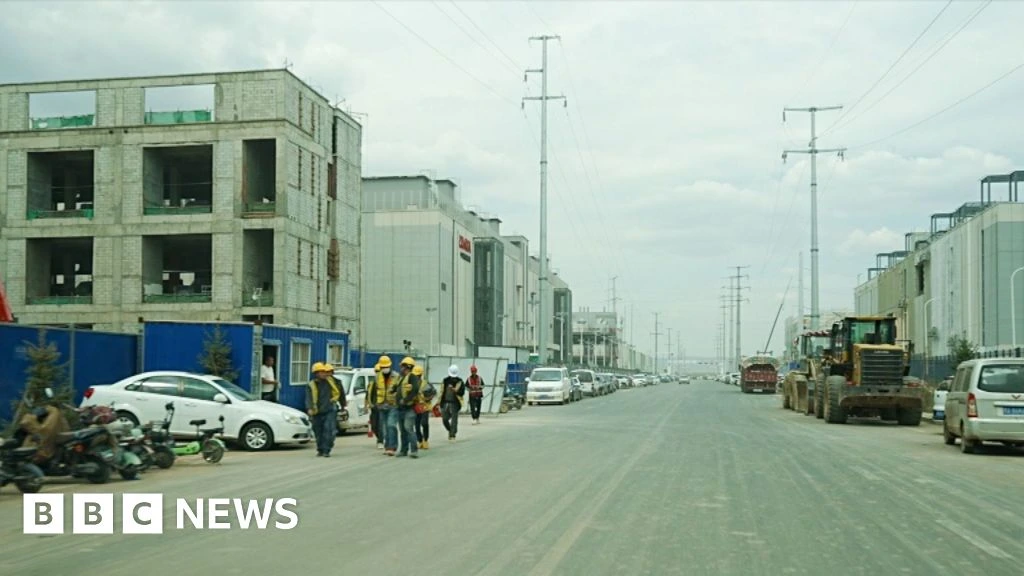
Hundreds of workers in yellow helmets carry heavy equipment into the building site as welding sparks fly off metal scaffolding. Above them huge cranes move with precision to build rooftops, while men balance on ladders to plaster brickwork.
Hundreds of workers in yellow helmets carry heavy equipment into the building site as welding sparks fly off metal scaffolding. Above them huge cranes move with precision to build rooftops, while men balance on ladders to plaster brickwork.
"This is China speed," jokes one worker. "An infrastructure maniac," is how he describes his country, laughing as he walks away. “There is one phase every year. This is the second phase," explains an electrical engineer. "There will be many more phases afterwards."
"This is China speed," jokes one worker. "An infrastructure maniac," is how he describes his country, laughing as he walks away. “There is one phase every year. This is the second phase," explains an electrical engineer. "There will be many more phases afterwards."
Artifical intelligence sits at the heart of China's contest with the United States and the key to it is the computing power inside the data centres here.
Artifical intelligence sits at the heart of China's contest with the United States and the key to it is the computing power inside the data centres here.
To the Chinese Communist Party, these buildings are critical for the country's economic and national security. Once finished, they will help drive its mission to embed AI across 90% of industries and society by 2030.
To the Chinese Communist Party, these buildings are critical for the country's economic and national security. Once finished, they will help drive its mission to embed AI across 90% of industries and society by 2030.
China's not just building the infrastructure. It's also creating a pool of talent: young engineers and researchers who now see their country as a place of opportunity, partly because tensions with the US and Trump's restrictions on immigration have soured the American dream.
China's not just building the infrastructure. It's also creating a pool of talent: young engineers and researchers who now see their country as a place of opportunity, partly because tensions with the US and Trump's restrictions on immigration have soured the American dream.
"Fewer students and researchers are heading to the US, and more are returning from the US to China. That is very clear," says Jack Zhang from the University of Science and Technology of China.
"Fewer students and researchers are heading to the US, and more are returning from the US to China. That is very clear," says Jack Zhang from the University of Science and Technology of China.
He himself was recruited by a high-level programme after studying at Yale in the US, and Cambridge in the UK.
He himself was recruited by a high-level programme after studying at Yale in the US, and Cambridge in the UK.
"I wanted to take some of the AI work I was doing in the lab and apply it to human health and medicine. That requires more resources, more people and sometimes more government support, which can be difficult to access overseas."
"I wanted to take some of the AI work I was doing in the lab and apply it to human health and medicine. That requires more resources, more people and sometimes more government support, which can be difficult to access overseas."
China's expanding AI capabilities are one reason why the US says it doesn't want to hit pause on its AI development, despite stark warnings from inside the industry that the technology was moving too fast.
China's expanding AI capabilities are one reason why the US says it doesn't want to hit pause on its AI development, despite stark warnings from inside the industry that the technology was moving too fast.
"Whoever wins AI, wins," President Trump said last week. The CEO of AI firm Anthropic, Dario Amodei, called for keeping the US-led ban on selling advanced chips and equipment to China, while warning that a Chinese lead would "pose grave danger for the US and the world".
"Whoever wins AI, wins," President Trump said last week. The CEO of AI firm Anthropic, Dario Amodei, called for keeping the US-led ban on selling advanced chips and equipment to China, while warning that a Chinese lead would "pose grave danger for the US and the world".
This is not what Xi will want to hear when he arrives in Washington on Wednesday. The state-run Global Times, which echoes Beijing, dismissed US fears as part of a "Cold War playbook" to "contain" China's rise.
This is not what Xi will want to hear when he arrives in Washington on Wednesday. The state-run Global Times, which echoes Beijing, dismissed US fears as part of a "Cold War playbook" to "contain" China's rise.
But China is not just focused on catching up to the US.
But China is not just focused on catching up to the US.
It is also touting an alternate model. Xi himself is encouraging Chinese AI firms to develop more affordable, open-source models - which allow people, companies and countries to modify it as they wish.
It is also touting an alternate model. Xi himself is encouraging Chinese AI firms to develop more affordable, open-source models - which allow people, companies and countries to modify it as they wish.
It also pits Chinese models against those in the US where developers including OpenAI and Anthropic use closed-model approaches, and their design elements are kept a secret.
It also pits Chinese models against those in the US where developers including OpenAI and Anthropic use closed-model approaches, and their design elements are kept a secret.
One reason Beijing is in favour of their approach is that it has worked well for them. By sharing the tech, Chinese AI firms have been able to innovate quickly.
One reason Beijing is in favour of their approach is that it has worked well for them. By sharing the tech, Chinese AI firms have been able to innovate quickly.
This has helped China overcome one of its biggest challenges: a lack of access to advanced chips, which would help unlock greater computing power.
This has helped China overcome one of its biggest challenges: a lack of access to advanced chips, which would help unlock greater computing power.
But Beijing also wants a bigger say in writing the rules that govern AI. Xi has repeatedly called for more regulation and a global framework for others to follow.
But Beijing also wants a bigger say in writing the rules that govern AI. Xi has repeatedly called for more regulation and a global framework for others to follow.
With calls for AI safety growing, this week's summit at the White House is especially significant. Can the two sides collaborate on regulating AI? Is any talk of a slowdown even realistic?
With calls for AI safety growing, this week's summit at the White House is especially significant. Can the two sides collaborate on regulating AI? Is any talk of a slowdown even realistic?
It certainly doesn't seem like that in places like Ulanqab, where China's AI ambitions are taking shape.
It certainly doesn't seem like that in places like Ulanqab, where China's AI ambitions are taking shape.
China is building hundreds of data centres - for Huawei, ByteDance, DeepSeek - in sparsely-populated provinces: Ulanqab, Ningxia and Gansu in the north, Guizhou in the south-west.
China is building hundreds of data centres - for Huawei, ByteDance, DeepSeek - in sparsely-populated provinces: Ulanqab, Ningxia and Gansu in the north, Guizhou in the south-west.
It has already built up vast renewable energy capacity - wind and solar - in these regions, land is cheaper and the weather cooler, so there is less demand for water.
It has already built up vast renewable energy capacity - wind and solar - in these regions, land is cheaper and the weather cooler, so there is less demand for water.
This doesn't mean there are no concerns or downsides. China wants most of its data centres to be fuelled by green energy by 2030 - but some of its grid is still fed by coal power. Water supply remains a concern in the arid, dry parts of Inner Mongolia.
This doesn't mean there are no concerns or downsides. China wants most of its data centres to be fuelled by green energy by 2030 - but some of its grid is still fed by coal power. Water supply remains a concern in the arid, dry parts of Inner Mongolia.
Entire villages have been relocated, although it's hard to pin down the number or what compensation residents were offered. It's a topic few people will discuss because it can be dangerous to voice concerns too openly.
Entire villages have been relocated, although it's hard to pin down the number or what compensation residents were offered. It's a topic few people will discuss because it can be dangerous to voice concerns too openly.
"This big data has absolutely nothing to do with ordinary people," says one local, speaking anonymously off camera. "What benefits has it brought us?"
"This big data has absolutely nothing to do with ordinary people," says one local, speaking anonymously off camera. "What benefits has it brought us?"
He says few locals had found jobs there. Others told us of fears that their land would be taken and they would no longer be able to farm for a living.
He says few locals had found jobs there. Others told us of fears that their land would be taken and they would no longer be able to farm for a living.
But there are optimists too, such as a man who told us his last name was Zhang, standing alongside potato pickers in a field near the data centres.
But there are optimists too, such as a man who told us his last name was Zhang, standing alongside potato pickers in a field near the data centres.
“China is now at the forefront of the world," he says, adding that his children have managed to find jobs there.
“China is now at the forefront of the world," he says, adding that his children have managed to find jobs there.
"It's not like the 1960s, when it was relatively backward. China is doing alright now. Whether in economic development or other areas, it is doing well."
"It's not like the 1960s, when it was relatively backward. China is doing alright now. Whether in economic development or other areas, it is doing well."
Surveys appear to suggest that there is little opposition to AI or its widespread adoption, compared to so many other countries, but it's hard to evaluate these figures in such a heavily-censored climate.
Surveys appear to suggest that there is little opposition to AI or its widespread adoption, compared to so many other countries, but it's hard to evaluate these figures in such a heavily-censored climate.
Beijing has been quite clear that it sees AI as a solution to its ageing workforce, and is rapidly automating manufacturing and production. That is producing anxiety over job losses, which, again, is hard to measure.
Beijing has been quite clear that it sees AI as a solution to its ageing workforce, and is rapidly automating manufacturing and production. That is producing anxiety over job losses, which, again, is hard to measure.
But this is also a country that is producing around five million science and tech graduates each year, compared to around half a million in the US.
But this is also a country that is producing around five million science and tech graduates each year, compared to around half a million in the US.
And as more of them stay in China, they see a growing ecosystem for innovation.
And as more of them stay in China, they see a growing ecosystem for innovation.
AI developer Dang Ronghao, 27, who works for a leading tech company says Chinese campuses are becoming more open, allowing him to talk to researchers all over the world from his base in Shanghai.
AI developer Dang Ronghao, 27, who works for a leading tech company says Chinese campuses are becoming more open, allowing him to talk to researchers all over the world from his base in Shanghai.
"I've seen research combining AI with nuclear fusion, AI with astrophysics, AI with new materials, and AI with the development of new drugs. I think we are entering a good era."
"I've seen research combining AI with nuclear fusion, AI with astrophysics, AI with new materials, and AI with the development of new drugs. I think we are entering a good era."
Even so, some argue that China still rewards conformity over challenge. "It's not as open as I wish," says Professor Liu Jun, Department of Statistics and Data Science at Tsinghua University. He has studied at both Harvard and Stanford.
Even so, some argue that China still rewards conformity over challenge. "It's not as open as I wish," says Professor Liu Jun, Department of Statistics and Data Science at Tsinghua University. He has studied at both Harvard and Stanford.
"I keep encouraging students here to ask more questions, to challenge more, but that's hard to change. I think partly it's culture, partly it's the system."
"I keep encouraging students here to ask more questions, to challenge more, but that's hard to change. I think partly it's culture, partly it's the system."
Far from the labs where Prof Liu and others are wrangling with the AI frontier, many Chinese people are still grappling with more immediate economic troubles: a sluggish economy, rising youth unemployment, low spending and property prices that have plummeted. In rural areas, an ageing population is also a growing concern.
Far from the labs where Prof Liu and others are wrangling with the AI frontier, many Chinese people are still grappling with more immediate economic troubles: a sluggish economy, rising youth unemployment, low spending and property prices that have plummeted. In rural areas, an ageing population is also a growing concern.
"Big data and all that… pretty good – but it has nothing to do with me," says one farmer in Inner Mongolia, as he trundles on a cart to check on his sheep.
"Big data and all that… pretty good – but it has nothing to do with me," says one farmer in Inner Mongolia, as he trundles on a cart to check on his sheep.
He says he has no use for AI. He hardly even uses the internet.
He says he has no use for AI. He hardly even uses the internet.
The screen on his phone is smashed, and wifi comes from a pocket dongle for which he pays just over 40 yuan a month.
The screen on his phone is smashed, and wifi comes from a pocket dongle for which he pays just over 40 yuan a month.
"There haven't really been any changes for me. I don't know about the future," he says.
"There haven't really been any changes for me. I don't know about the future," he says.
This kind of scepticism can become a challenge for Beijing.
This kind of scepticism can become a challenge for Beijing.
So much is changing here and everywhere else in the country, but it's hard to know how many people are as invested as their leaders in this tech-charged future.
So much is changing here and everywhere else in the country, but it's hard to know how many people are as invested as their leaders in this tech-charged future.