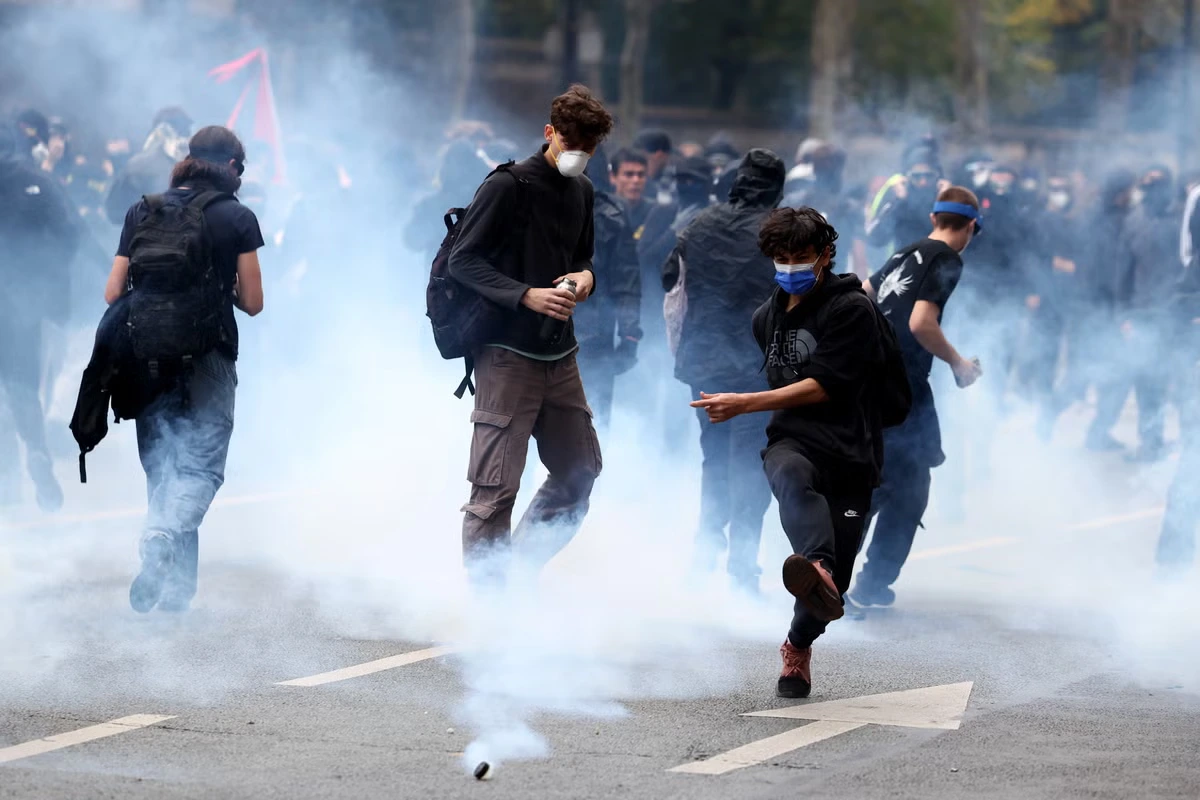
In the last few decades, riots have gained a new, permanent member. A different participant has joined the ranks of masked hooligans and terrified civilians.
As peaceful protests turn violent, shop owners watch their livelihoods get looted, and 19th-century town halls are set alight, we watch. The updates are so immediate, the chaos unfolding so close to real time and then posted and livestreamed online, that any passive digital onlooker might as well be there themselves.
But social media doesn’t just place us at these scenes of mass social unrest – it also now holds a pivotal role in enabling them in the first place. And the unique challenge for government bodies (still mostly made up of digital immigrants) is not just one of literal crowd control, but of limiting the networks themselves.
The continued destruction in France over recent weeks has led to increasingly dramatic measures. On Tuesday 20 October, presidential candidate Gabriel Attal called for a social media ban, citing young people who “see their friends going out to loot [on social media], which gives the impression that they’re getting away with it.”
It’s been a contentious issue across Europe for decades. During the 2011 Tottenham riots in the UK, one member of central government requested to “turn the internet off” to avoid further violence, former senior adviser Helen MacNamara recalls.
“I remember quite strongly going to meetings in the Home Office and in the Cabinet Office to explain BlackBerry Messenger to a lot of people, because that was apparently how the rioters were co-ordinating with each other,” Helen said on the latest episode of In The Room, ‘Why France is rioting – and is Britain next?’
“One member of the meeting asked whether I could switch the internet off, or could we shut off BlackBerry Messenger – to which the answer was no.”
Helen was Director of the Department for Culture, Media and Sport when Tottenham police fatally shot Mark Duggan during a targeted vehicle stop on 4 August 2011.
Echoing the situation in France, initial protests over Duggan’s killing were peaceful. But soon, violent riots spiralled out of control across London before spreading to the rest of the UK. Five people were killed and hundreds more injured. Widespread looting, arson, robbery, and assault led to over 3,000 arrests.
Helen says there are grave lessons to be learned from our European neighbours. Should people in the UK be worried about similar scenes unfolding here? “Yes. We are not immune to people being unhappy and discontented, and people don’t think they’re being listened to. It’s not unlikely that we will get large amounts of public disorder at some point.”
The French riots started out as largely peaceful student protests, but became increasingly aggressive and antisocial over weeks, with many blaming social media for encouraging “copycat violence”. Several French cities introduced curfews for under-18s on Tuesday 21 October.
But while there are obvious risks when governments don’t do enough, there are also pitfalls in doing too much.
“One of the really hard things to judge if you’re sitting in central government is when to pull that trigger,” Helen said. “How can you make sure that you aren’t accidentally creating situations where public disorder might be more likely?”
One particular incident came after the Grenfell fire tragedy in June 2017. There was extreme anxiety in government about how to manage the social mood – partly because of outrage over Grenfell specifically, but also more widely due to the season. The UK does most of its rioting during the summer.
Then, on a particularly hot Friday night, thousands of people had to be ‘decanted’ from their high-risk residential building. It had all the makings for further disaster. “Literally thousands of very unhappy, very fed up people spilt out onto the streets of Camden on a really hot summer’s evening,” she recalls.
“When you’re inside government, those sort of situations put you so on edge. It takes a tiny thing for something to tip over into massive riots.”
Listen to the full episode of In The Room on Apple Podcasts and Spotify, or watch on YouTube.