In January of 1971, the American art historian Linda Nochlin published a landmark essay, Why Have There Been No Great Women Artists? It was a provocation and a call to arms that was to send shockwaves through the arts establishment.
“It wasn’t just a problem for artists,” says Ce Roser, more than half a century on. “My older friends could not get shows, although they had had brilliant careers before, and that happened also to all of my friends who were poets or writers. Nobody seemed to be able to establish themselves as career artists. So we got together, we complained, and I decided we should have a meeting and really talk seriously about it.”
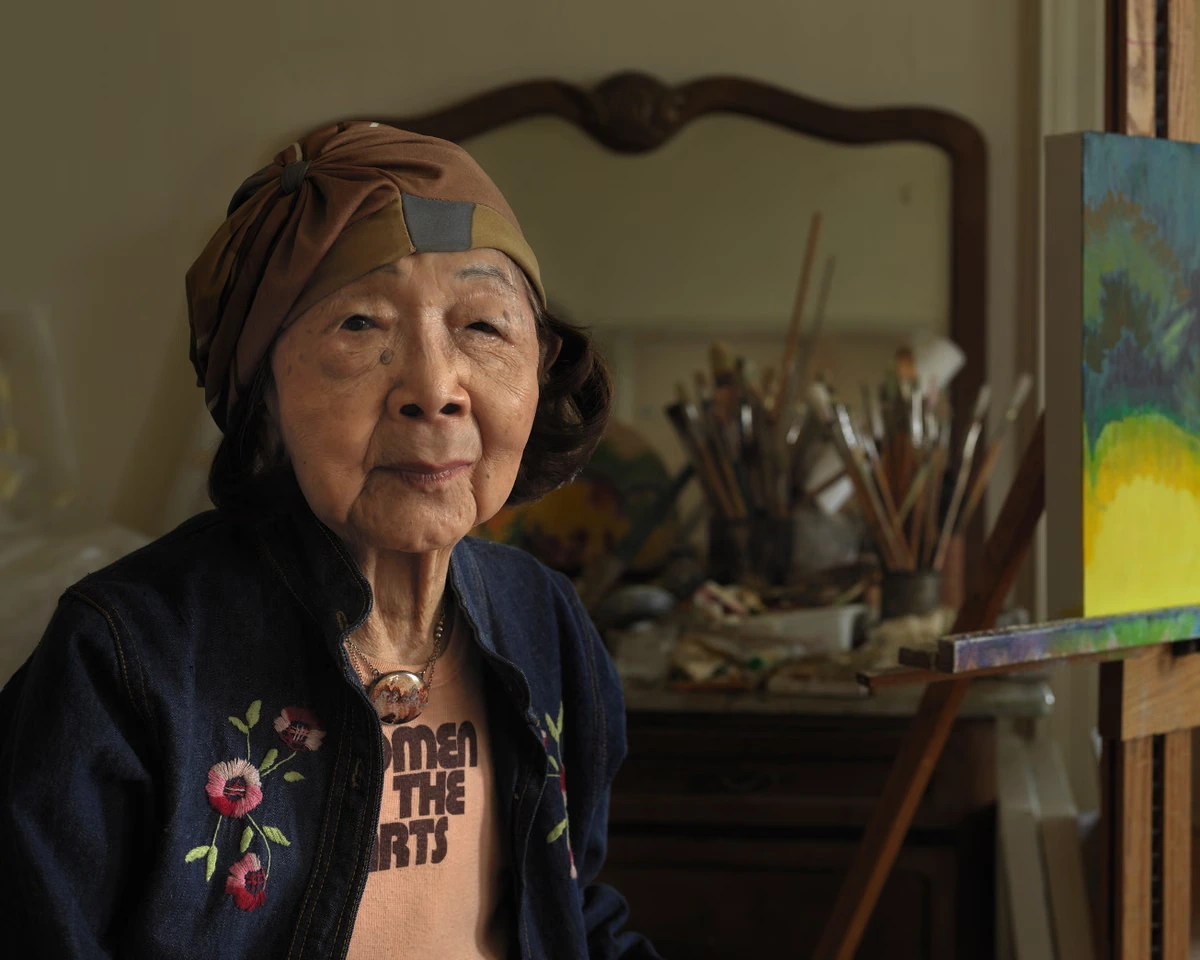
That first meeting at Roser’s home in New York led to the establishment of the Women in the Arts Foundation, which took to the streets to force a change in the status quo. As well as being a priceless witness to an activist movement that altered history, she is also making her own history at London’s VeneKlasen gallery this month, as the first American artist to make their European debut as a centenarian.
Meeting Roser over video link in her New York home, everything about her is surprising: she is 101 but could pass for 30 years younger. She was born in the US to Chinese parents, but insists that she never experienced racial discrimination. She doesn’t buy the idea that female artists, herself included, are constantly reforgotten today, as they were in the past. Her memory is as sharp and bright as the art she continues to make in the studio where she has worked for more than 70 years.
Of that formative moment in 1971 she recalls: “There was a school of thought that we’re middle-class women, and we are afraid to assert ourselves.” At first only a handful of people were involved, but by the third meeting, the artist Elaine de Kooning had offered her studio. “And by word of mouth, because they wanted to see Elaine’s studio, many more turned up, and we decided we would demonstrate.”
The father of one artist was a police officer, who said he could close down 53rd Street in front of the Museum of Modern Art. “So we took advantage. We decided we were going to have a joyous demonstration. We were not going to be like the men and be fierce and aggressive. Of course, we were aggressive, but we weren’t fierce.”
The protesters were an A to Z of art history as we know it today. Joan Mitchell appeared off the plane from France. Louise Bourgeois stood in front of MoMA holding a big sheet with NO written on it. Pat Passlof brandished a sign that declared: “MoMa loves Papa.” “We made a lot of noise. We danced in the street. We closed it off,” says Roser.
The payoff came in 1973, with an offer from the New York Cultural Center to host a show curated by, and featuring, female artists. Roser was one of seven selectors who, in a radical break with tradition, devised a democratic system in which artists nominated each other. Featuring 111 artists, Women Choose Women was hailed as a success that promised women “a large and permanent share of the art world action”, while also proving the value and efficiency of new, democratic forms of curation.
By the time of the protests, Roser was in her 40s, the widely travelled wife of a US diplomat, who had returned home because their son needed to go to school. “He was speaking Urdu, Tagalog, German, and no English for him to become an American,” she says.
Roser herself was a third generation American – the granddaughter of immigrant farmers from China to California, where one grandfather had a hop farm. Her parents had met at university, where her father was studying law and her mother maths and history, and she was the second of six children born to the couple after they settled in Philadelphia. “I didn’t feel Chinese because I grew up in a culture where there were very few Chinese,” she says. “My parents ate American food for breakfast, and you can tell a lot by what people eat for breakfast.”
She was introduced to the arts at an early age by a mother who would pay her children five cents for every poem they memorised, while keeping them quiet by sitting them down at the dining table with “lots of crayons and watercolours and paper”. But Roser had no inkling that art might be her vocation and, by 19, was working in the information department at the US embassy, where she met her husband. By 21 she was married and, on postings abroad, found herself hampered by “the many things foreign service wives were not allowed to do …”
Fortunately, on their third posting, to the Philippines capital Manila, a sympathetic friend lent her a paint set. “I did a painting from a photograph, and when my husband went to frame it, somebody wanted to buy it, so I decided it must be good,” she says.
In the late 1940s the couple were sent to Berlin, where Roser joined the Berlin Art Academy and studied under the German sculptor and Holocaust survivor Hans Uhlmann. She dismisses the suggestion that postwar Germany must have been a culture shock, saying that nothing could compare with what she had experienced as a teenager on a visit to an uncle in wartime China, when the family got trapped in Shanghai. “We rode on a boxcar for 40 days. My mother and my grandmother – no men – and my brothers and sisters, and four cousins she insisted upon bringing with us. So I was used to war-torn and bombed-out places.”
Uhlmann, she says, “would make us draw a thing from reality and turn it into an abstraction, and take an abstraction and turn it into reality on paper.” He said one thing that she particularly cherishes: “When you paint, be very definite. Do not hesitate. Just do it.”
Back in New York, she found the studio overlooking the Hudson River where she has worked ever since. “When I went into my studio, I felt like a hand going into a glove,” she recalls. “It wiped out the domestic. I didn’t cook, I didn’t clean. I was there to paint and do nothing else, though I would always also read. I restricted myself to art criticism, art history, or poetry. Nothing else.”
In the bright abstract paintings on display in her retrospective, the rhythms of poetry combine with the brushwork of calligraphy, which she studied under the Japanese master Nankoku Hidai. Whereas Hidai taught her to paint in broad strokes, “and to use my arms instead of my wrists”, poetry remains a key source of inspiration. “You mention a line and I see a painting,” she says.
Although her name isn’t as well known as it once was, she still paints away in her eyrie above the Hudson River, sometimes turning out two or three pictures a day, confident in the knowledge that she has works stowed away for posterity in all the New York institutions she once protested against.