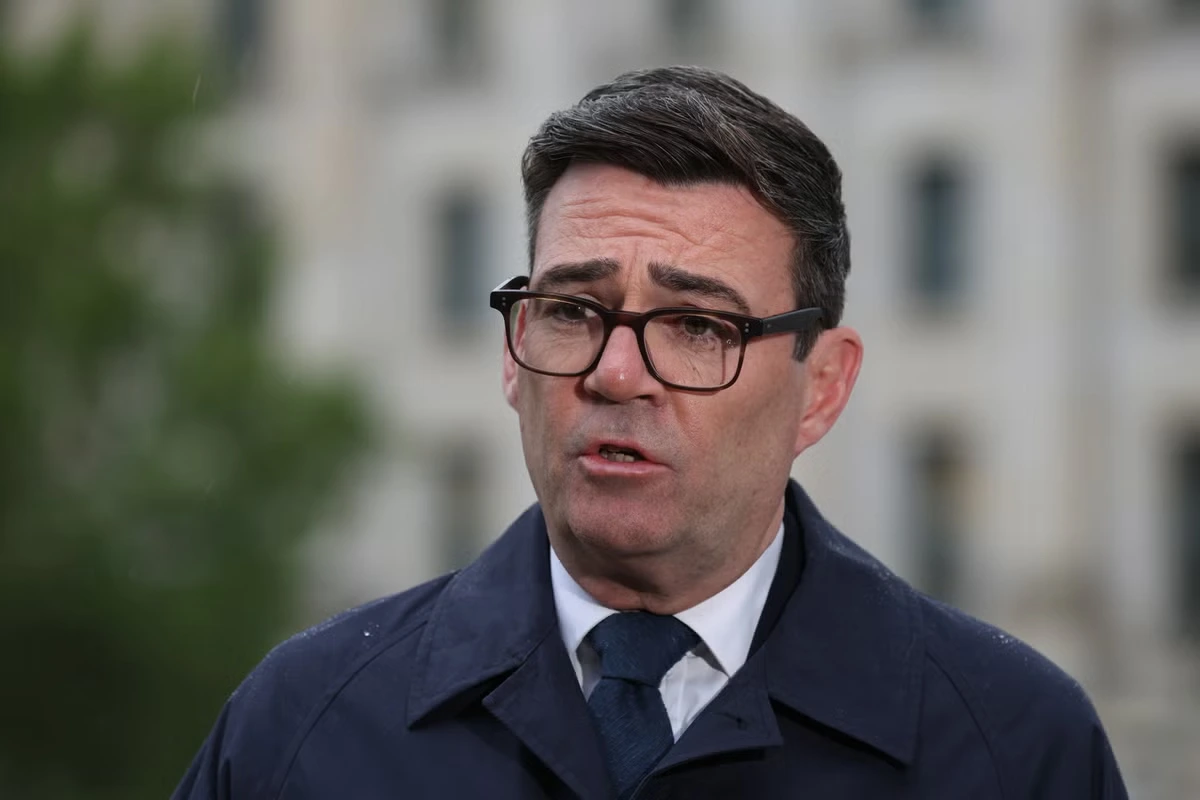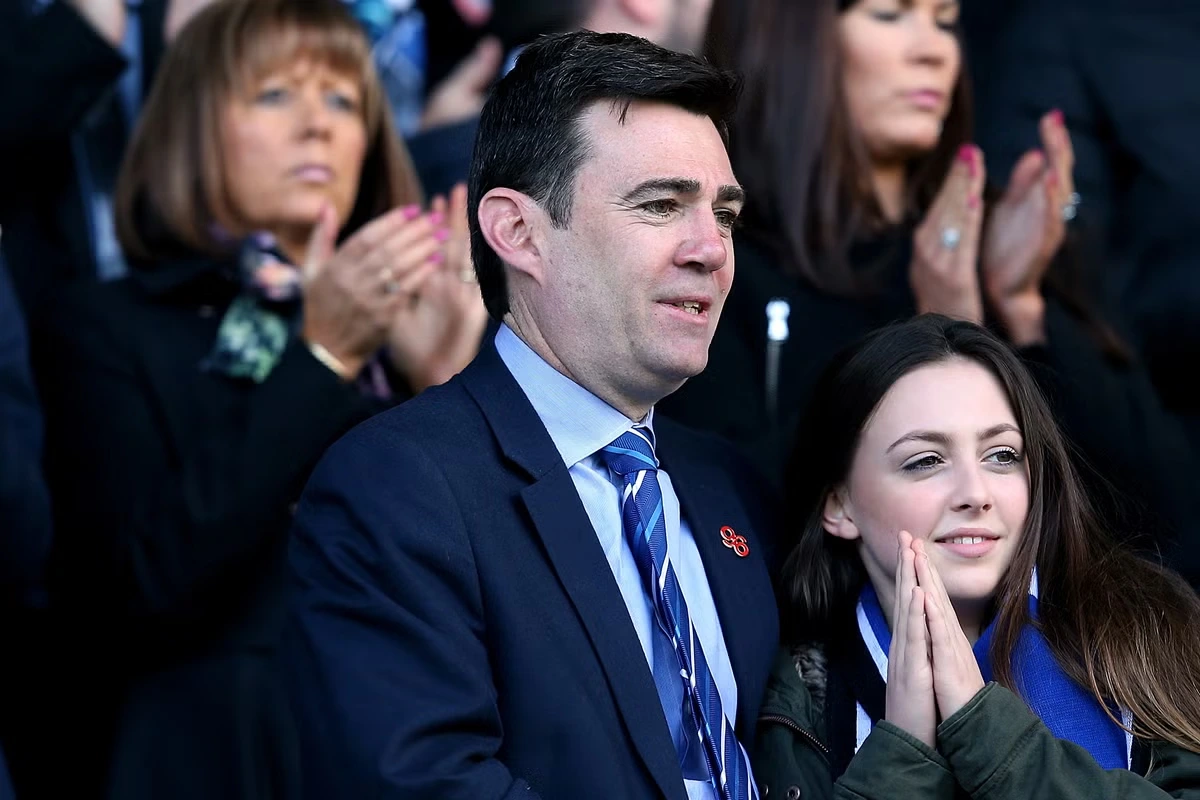
There is a joke about Andy Burnham that periodically crops up among Labour MPs, or so the legend goes. In it, a Blairite, a Brownite and a Corbynite all walk into the proverbial bar – only for the barman to respond with “Alright, Andy?”
It’s intended as a snarky dig at the new Labour leader’s reputation as a bit of a political shapeshifter, all things to all people. But at a stretch, you could craft a pretty similar punchline about his North West roots – a scouser, a “wool” and a Manc all striding into that same bar at once.
Over nearly a decade as mayor, Burnham has beaten the drum for Manchester so hard that you’d be forgiven for assuming he’s a city native. They’re so synonymous that his political vision is known as “Manchesterism”. He never misses a chance to name-drop New Order and The Smiths, and he got Liam Gallagher to be the voice of the Bee Network tram, for goodness sake.
But Burnham was in fact born about 30 or so miles down the M62 in Liverpool, the North West’s other cultural hub. His regional identity, then, straddles one of the UK’s great rivalries. It’s not just about football – these two cities have been jostling for superiority since the industrial revolution (Liverpool had the docks, but Manchester had the mills).
The prime minister-to-be spent the first year of his life in Old Roan, part of Aintree, the town best known for hosting the Grand National each spring. When his father Roy, a telecoms engineer, got a promotion that meant he’d be working in Manchester, the family decamped to the village of Culcheth, near Warrington, bang in the middle of the two cities.
It’s one of those nearly-scouse-but-not-quite hinterlands, so according to the vaguely Byzantine rules that govern who’s in and who’s out, scouse-wise, Burnham grew up as a “wool” (the jokily derogatory term levelled at out-of-town “woollybacks”, who’d provide scab labour in the city’s docks). “Definitely a plazzy scouser” is how James*, who has lived in both Liverpool and Burnham’s Manchester, describes him – plazzy being plastic, a sort of fake or put-on scouseness that can raise eyebrows among more quote-unquote authentic Liverpudlians.
So how, then, is all this chatter about Manchester’s future No 10 North going down in Burnham’s birthplace? “My issue is that ‘the North’ just seems to be Manchester,” says Gina*, who lives in Liverpool city centre; for her, Manchester just feels like “London 2.0”. There is a sense that it is already a big focus for investment – and that we could do with spreading the love elsewhere and recognising that the North is not a monolith.
And while Manchester has undoubtedly boomed under Burnham, the explosion of developments has also made it a far less affordable place to live for renters; this summer, stats showed it has overtaken London as a hub for buy-to-let investment from would-be landlords. This is not a slice of “Manchesterism” that many of us on the other end of the motorway would rush to embrace.
Speak to business leaders in Merseyside about Burnham, though, and they’re pretty positive. Paul Corcoran, founder of Liverpool’s Agent Marketing, says he is “genuinely excited by the prospect of a prime minister who understands the realities of running and growing businesses outside of London”, adding that it “feels refreshing” for that “to be represented at the highest level”.
Meanwhile, Jane Gaston, chief executive of Net Zero North West, believes that Burnham’s roots “give him a genuine understanding of both Liverpool and Manchester, and that broader perspective could be valuable”. Although the latter has “often been held up as a success story”, she notes, “this shouldn’t be viewed as a competition between northern cities”.
Liverpool has certainly been an important influence on Burnham. He traces his political awakening back to watching Boys from the Blackstuff, Alan Bleasdale’s drama that followed five scouse tarmac layers against a backdrop of post-industrial decline; when it aired in 1982, it resonated as a grim indictment of mass unemployment under Margaret Thatcher.
For Burnham’s mother Eileen, whose father drove a lorry around the docks for the sugar company Tate & Lyle, the show hit home. “There was one particular episode that was very much about the decline of the Liverpool docks and I remember as a child turning to see my mum with tears coming down her face,” he recalled in Look North, the book he co-wrote with Steve Rotheram, mayor of the Liverpool City Region, a longtime close friend and ally.
There’s the Everton connection, too. Burnham is a lifelong supporter of the Toffees, and during his 2015 Labour leadership run admitted that he would never give up his season ticket, even if he became prime minister.
His Evertonian identity has become a key part of Burnham’s “everyman” schtick – here’s a guy, this persona suggests, who understands the travails of supporting your childhood team through interminable frustration and brief bouts of euphoria. Enduring the gruelling rollercoaster of supporting Everton is, I’d argue, a test of resilience akin to political high office – the highs, the lows, the humiliations.
It’s surely no coincidence that, when he was photographed out jogging shortly after he’d announced his intention to run in the Makerfield by-election, he did so in a 1979-80 season Everton shirt. Not everyone’s won over by Burnham’s fandom, though. “Him ‘being an Evertonian’ is going to be the new ‘my father was a toolmaker,’” one friend suggests.
One thing no one can deny is the weight of Burnham’s most important football-related contribution to the city – his commitment to gaining justice for the victims of the Hillsborough disaster and their families. “I’ve always thought him a great guy with integrity, and will always be grateful for him taking the Hillsborough cause and running with it,” Liverpudlian Joy Swift tells me.
Ninety-seven people died after being injured in the crush at a football match between Liverpool and Nottingham Forest in April 1989, the UK’s worst-ever sporting tragedy. It was eventually ruled that they were unlawfully killed, after multiple failings by the police and the emergency services, but it took decades of campaigning to reach this point.
In 2009, during his stint as culture secretary, Burnham delivered a speech at Anfield to mark the tragedy’s 20th anniversary, but was drowned out by heckles and boos from the crowd. “It felt like I was standing on the edge of the abyss between the government I was in and the people with whom I had grown up,” he later reflected.
Not long after, he told the then prime minister Gordon Brown that he planned to raise Hillsborough in their next cabinet meeting. It was a move that would lay the foundations for the Hillsborough Independent Panel, which concluded no Liverpool fans were responsible for the deaths, dispelling vile myths that had been spread in the wake of the tragedy.
One of Burnham’s last moves during his previous time in Westminster was to introduce a Hillsborough Law bill to parliament, aiming to prevent future institutional cover-ups by creating a legal obligation for public officials to act transparently.
Earlier this week, it was finally approved, bringing the returning MP full circle. “He has always striven to serve the ‘ordinary’ people and listen to what we have to say,” Liverpool resident Paula* tells me, highlighting not just his work for the Hillsborough campaign, but also his advocacy for Grenfell victims and nuclear test veterans.
That certainly goes down well in a city that tends to value solidarity and transparency. “I like him very much as a person – he comes across as sincere, intelligent, engaged,” Paula adds.
She is also pleased that he looks set to drop the NHS’s partnerships with Palantir, the controversial US tech company that holds contracts with US Immigration and Customs Enforcement (ICE) and the Israeli military, which she describes as “a great start”. She does, however, fear “that he will fall victim to the usual pressures of the lobbying business interests”.
For the most part, though, she says she is hopeful that he will be a force for change within the Labour Party and politics as a whole. It’s a lot to put on the shoulders of one “plazzy scouser”. He’ll be back in his birthplace for the Labour conference come September. Whether he gets a hero’s welcome from the locals will depend on whether he can live up to the hype.
*Names have been changed for anonymity