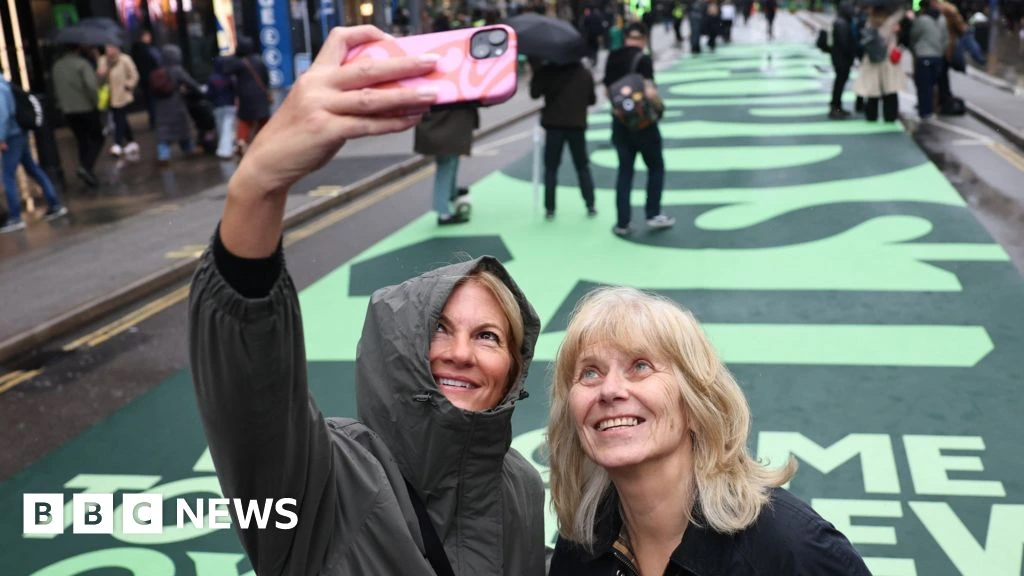
Part of Oxford Street has been pedestrianised, with visitors experiencing the first day that cars, taxis, buses and bicycles have been banned from some of the central London street.
Part of Oxford Street has been pedestrianised, with visitors experiencing the first day that cars, taxis, buses and bicycles have been banned from some of the central London street.
cars, taxis, buses and bicycles have been banned from some of the central London streetAlmost 1km (0.62-mile) of the popular shopping destination has been pedestrianised between Orchard Street and Great Portland Street by the mayor's Oxford Street Development Corporation.
Almost 1km (0.62-mile) of the popular shopping destination has been pedestrianised between Orchard Street and Great Portland Street by the mayor's Oxford Street Development Corporation.
the mayor's Oxford Street Development CorporationThe change has been welcomed by some shoppers, although questions have been raised about how accessible it will be for disabled visitors.
The change has been welcomed by some shoppers, although questions have been raised about how accessible it will be for disabled visitors.
London's mayor Lord Sadiq Khan said it was a "momentous day for London", and the changes were the first phase in lifting the street out of "decline".
London's mayor Lord Sadiq Khan said it was a "momentous day for London", and the changes were the first phase in lifting the street out of "decline".
The roll-out was met with some confusion as many cyclists continued to pedal through the newly-installed barriers, with some being shouted at by security staff to "dismount" and walk their route instead.
The roll-out was met with some confusion as many cyclists continued to pedal through the newly-installed barriers, with some being shouted at by security staff to "dismount" and walk their route instead.
Whether this is a teething problem or a constant enforcement issue remains to be seen in the weeks and months to come.
Whether this is a teething problem or a constant enforcement issue remains to be seen in the weeks and months to come.
A police officer was also seen getting to grips with the new arrangement, as he asked an Oxford Street security worker: "How do I get my car down there?"
A police officer was also seen getting to grips with the new arrangement, as he asked an Oxford Street security worker: "How do I get my car down there?"
But as shoppers started to descend on the street, many celebrated the change.
But as shoppers started to descend on the street, many celebrated the change.
Lucia, who works nearby, said she took a detour to see the newly pedestrianised street.
Lucia, who works nearby, said she took a detour to see the newly pedestrianised street.
"It's very joyful," she said. "We are used to walking on crowded pavements, so it's really exciting to see the people using this space."
"It's very joyful," she said. "We are used to walking on crowded pavements, so it's really exciting to see the people using this space."
"Let's see how it regenerates with time, how different types of businesses pop out, how different spaces for people to hang out appear.
"Let's see how it regenerates with time, how different types of businesses pop out, how different spaces for people to hang out appear.
"I think in summer it will be lovely. Christmas will be great, it will be more enjoyable."
"I think in summer it will be lovely. Christmas will be great, it will be more enjoyable."
Her views were echoed by others, and as the day went on, more people could be seen walking on the newly changed road rather than sticking to the pavement.
Her views were echoed by others, and as the day went on, more people could be seen walking on the newly changed road rather than sticking to the pavement.
However, concerns were raised by some about accessibility, and whether the re-routed buses and new bus stops and taxi ranks, installed about 200m and 100m from the pedestrianised area respectively, would be enough to support disabled shoppers.
However, concerns were raised by some about accessibility, and whether the re-routed buses and new bus stops and taxi ranks, installed about 200m and 100m from the pedestrianised area respectively, would be enough to support disabled shoppers.
One black cab driver who spoke to BBC London said he was worried that access to Oxford Street would "become a problem" for some of his disabled passengers.
One black cab driver who spoke to BBC London said he was worried that access to Oxford Street would "become a problem" for some of his disabled passengers.
Last week, chair of Inclusion London, Adam Gabsi, said "the proof will be in the pudding".
Last week, chair of Inclusion London, Adam Gabsi, said "the proof will be in the pudding".
"If access to buses and taxis becomes difficult, then there'll be problems for people like me," he said, adding that although disabled Londoners were consulted on the plan, it was not co-produced by them.
"If access to buses and taxis becomes difficult, then there'll be problems for people like me," he said, adding that although disabled Londoners were consulted on the plan, it was not co-produced by them.
Sight loss charity Guide Dogs welcomed the changes, and Wheels for Wellbeing argued that accessibility needed to be properly built into the final design.
Sight loss charity Guide Dogs welcomed the changes, and Wheels for Wellbeing argued that accessibility needed to be properly built into the final design.
Michael Bolt, from the Marylebone Association, was among a number of locals who said they feared surrounding areas would be "ruined" as traffic was displaced on to other roads.
Michael Bolt, from the Marylebone Association, was among a number of locals who said they feared surrounding areas would be "ruined" as traffic was displaced on to other roads.
Karen Jones, who has lived in the area for 20 years, also said she was worried what would happen to their "beautiful garden neighbourhoods".
Karen Jones, who has lived in the area for 20 years, also said she was worried what would happen to their "beautiful garden neighbourhoods".
Lord Khan said he wanted people to be "in charge" of Oxford Street, not traffic, and hoped it would become a site for "culture, leisure and tourism".
Lord Khan said he wanted people to be "in charge" of Oxford Street, not traffic, and hoped it would become a site for "culture, leisure and tourism".
"This is a street that has been known as the nation's high street for more than 100 years," he said.
"This is a street that has been known as the nation's high street for more than 100 years," he said.
"Over the last couple of decades it's been in decline.
"Over the last couple of decades it's been in decline.
"I'm not willing to stand by as shops leave this street, as jobs leave this street, and that's why I'm really proud 1km of this street is traffic free."
"I'm not willing to stand by as shops leave this street, as jobs leave this street, and that's why I'm really proud 1km of this street is traffic free."
The mayor said the area would be "safe and spacious" in the lead-up to Christmas, with more improvement works coming in the new year.
The mayor said the area would be "safe and spacious" in the lead-up to Christmas, with more improvement works coming in the new year.
"We're going to carry on testing and learning, refining the plans we have to make sure everyone gets to enjoy this street," he said.
"We're going to carry on testing and learning, refining the plans we have to make sure everyone gets to enjoy this street," he said.
"We don't want it to be horrible, we want it to be great.
"We don't want it to be horrible, we want it to be great.
"We are going to learn from this first phase to make sure the next phase takes on people's concerns."
"We are going to learn from this first phase to make sure the next phase takes on people's concerns."
Seb Dance, London's deputy mayor for transport and deputy chair for Transport for London (TfL), said "people will see very quickly the benefits" of pedestrianisation.
Seb Dance, London's deputy mayor for transport and deputy chair for Transport for London (TfL), said "people will see very quickly the benefits" of pedestrianisation.
TfL previously told BBC London it expected to see "a manageable increase in traffic" on Wigmore Street, Cavendish Place, Henrietta Street, Marylebone Lane and Welbeck Street.
TfL previously told BBC London it expected to see "a manageable increase in traffic" on Wigmore Street, Cavendish Place, Henrietta Street, Marylebone Lane and Welbeck Street.
Tim Barnes, deputy leader of Westminster City Council, said residents had regularly raised issues with pedestrianisation of Oxford Street whenever a scheme was proposed in the past.
Tim Barnes, deputy leader of Westminster City Council, said residents had regularly raised issues with pedestrianisation of Oxford Street whenever a scheme was proposed in the past.
"We just couldn't find ways that would practically work," he said.
"We just couldn't find ways that would practically work," he said.
"I think we need to see a lot of how this works in practice. We will be monitoring for traffic problems or noise problems, pollution issues, and taking those back to TfL and the mayor, and charging them with the responsibility of fixing those problems if they've created them."
"I think we need to see a lot of how this works in practice. We will be monitoring for traffic problems or noise problems, pollution issues, and taking those back to TfL and the mayor, and charging them with the responsibility of fixing those problems if they've created them."
The Oxford Street Development Corporation, which is leading the change, previously said it had worked with the emergency services to understand their access needs to Oxford Street, and would continue to do so as the changes unfold.
The Oxford Street Development Corporation, which is leading the change, previously said it had worked with the emergency services to understand their access needs to Oxford Street, and would continue to do so as the changes unfold.
It said police, ambulances and the fire service would be able to access the pedestrianised areas along "multiple access points".
It said police, ambulances and the fire service would be able to access the pedestrianised areas along "multiple access points".
The project, which is estimated to cost about £150m, will see gradual changes unfold along the road, with road surfaces being raised, trees and seating installed, and traffic lights rephased.
The project, which is estimated to cost about £150m, will see gradual changes unfold along the road, with road surfaces being raised, trees and seating installed, and traffic lights rephased.
The corporation said "possible future phases are being considered and costed".
The corporation said "possible future phases are being considered and costed".
Kate Boothman Meier, director of corporate affairs at New West End Company, said: "The ultimate aim is to try and pedestrianise the wider Oxford Street. That is further down the line, we have to see how this goes first."
Kate Boothman Meier, director of corporate affairs at New West End Company, said: "The ultimate aim is to try and pedestrianise the wider Oxford Street. That is further down the line, we have to see how this goes first."
Additional reporting by James W Kelly, Gem O'Reilly, Lauren Stanley from BBC London and Tom Edwards, BBC London transport correspondent.
Additional reporting by James W Kelly, Gem O'Reilly, Lauren Stanley from BBC London and Tom Edwards, BBC London transport correspondent.
Additional reporting by James W Kelly, Gem O'Reilly, Lauren Stanley from BBC London and Tom Edwards, BBC London transport correspondent.Listen to the best of BBC Radio London on Sounds and follow BBC London on Facebook, X and Instagram. Send your story ideas to [email protected]
Listen to the best of BBC Radio London on Sounds and follow BBC London on Facebook, X and Instagram. Send your story ideas to [email protected]
Listen to the best of BBC Radio London on SoundsSounds and follow BBC London on FacebookFacebook, XX and InstagramInstagram. Send your story ideas to [email protected][email protected]