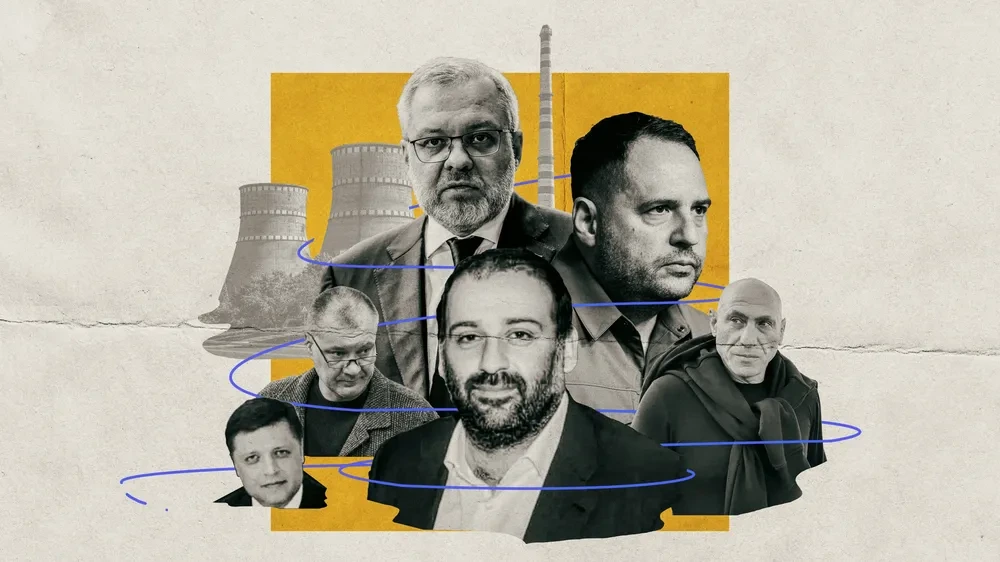
Exactly why Herman Halushchenko boarded the night train from Kyiv to Poland on the evening of February 14 is still not entirely clear. The 53-year-old would later say he had wanted to visit his children in Switzerland. But it is also possible that Ukraine's long-serving energy minister was trying to flee. Either way, he did not get far.
At the border, Ukrainian officers knocked on the doors of the sleeper compartments and collected the passengers' passports. When they scanned Halushchenko's ID, the system issued an alert: the former minister was barred from leaving the country. The border guards pulled him off the train, placed him under arrest and, a few hours later, handed him over to investigators from the National Anti-Corruption Bureau of Ukraine (NABU). »Operation Midas« is what the NABU investigators have named what is likely the most spectacular corruption case the country has seen in years. With Halushchenko's arrest on that frigid February night, Midas had reached the highest levels of the Ukrainian state.
As minister, Herman Halushchenko was responsible not only for the country's energy supply but also for protecting the critical energy infrastructure that Russia targeted throughout the winter. For several weeks, many residents of Kyiv, Kharkiv and Dnipro were forced to endure temperatures as low as minus 20 degrees Celsius inside their apartments – a situation some referred to as a humanitarian catastrophe. Which makes the investigators' allegations all the more damning: Halushchenko is said to have played a leading role in a ring whose corrupt schemes delayed the construction of protective installations for the energy grid.
The multimillion-dollar scandal reaches into the very heart of the Ukrainian government. Just a few days ago, a court ordered pretrial detention for Andriy Yermak, long the closest and most powerful confidant of President Volodymyr Zelenskyy. In addition to Halushchenko, another minister has also lost her post. Indeed, even Zelenskyy's own integrity is now being called into question. German Chancellor Friedrich Merz, sources in Berlin say, has personally spoken with the Ukrainian president about the case on several occasions and pressed for full disclosure. How the affair is handled will be a key test as to whether Ukraine can meet European Union standards. Whether the rule of law can summon the strength to prevail over the kleptocratic networks that descended on the country after the collapse of the Soviet Union. And whether Moscow's propaganda – that Ukraine is corrupt through and through – can be rebutted. Ukraine currently ranks 104th on Transparency International's Corruption Perceptions Index. Russia ranks 157th.
Operation Midas involves money laundering, hidden funds and accounts in Caribbean tax havens, luxury apartments in Kyiv and an elite Swiss boarding school. At a minimum. Halushchenko, a diamond dealer and other alleged accomplices are said to have pocketed more than $112 million in kickbacks between them. At the center of it all sits the state-owned conglomerate Energoatom, which produces roughly half of Ukraine's electricity.
A DIE ZEIT reporting team has reviewed investigation files, wiretap transcripts, financial records and videos relating to the case. Reporters traveled to Kyiv and spoke with investigators and with defense attorneys representing the accused. They interviewed members of parliament and financial experts in London, Geneva and Frankfurt, and they consulted with security agencies, diplomats and a former German cabinet minister. It is an attempt to reconstruct an alleged corruption scheme whose full scope and political fallout are still impossible to gauge.
The Operation Midas investigation is headed up by Semen Kryvonos, the head of NABU. Kryvonos receives his visitors in Kyiv at a circular table of heavy wood. On a sideboard lies a baseball bat, a gift from the FBI. Kryvonos has a reputation for tenacity, and his record of successful investigations is held up as evidence that Ukraine is serious about fighting corruption.
When asked when the alleged plundering of Energoatom began, Kryvonos goes all the way back to 2020. That, he is convinced, is when two men who could hardly have been more different joined forces: Timur Mindich, the diamond dealer. And Herman Halushchenko, the ex-minister who was arrested on the night train to Poland. The one a bon vivant, the other an apparatchik. The one bald, with round glasses and a bushy white beard. The other wears his gray hair severely parted and his ties perfectly knotted, and he almost always dresses in a suit. For one of those suits, an investigator says, Halushchenko apparently paid 10,000 euros in Austria.
The Diamond Dealer and the Minister
Timur Mindich presides over a web of dozens of companies spanning film production, real estate, wholesale trade and financial services. His synthetic diamonds are sold in luxury boutiques as far away as New York. In 2010, Mindich – who holds both Israeli and Ukrainian citizenship – celebrated his wedding in Jerusalem with 500 guests.
Mindich has many powerful friends, one of them being President Zelenskyy. The two were partners in the film production company Kvartal 95, which made the satirical show that turned Zelenskyy into a star. Until 2019, Mindich and Zelenskyy also ran a company called Green Family Ltd., which is registered in Cyprus. In 2021, Mindich hosted a birthday party for the president at his luxury apartment in Kyiv.
NABU investigators intercepted countless conversations Mindich held with ministers, presidential advisers and prominent business figures. In those conversations, it appears he was fond of making sure people know how close he was to Zelenskyy.
While Mindich was building a career in business and cultivating contacts in the highest circles, Halushchenko was climbing the ranks of the civil service. Raised in Soviet times, he studied law and worked in several ministries before becoming deputy president of Energoatom in 2020. One year later, he was promoted to energy minister and then moved to the justice portfolio in July 2025. Of all places.
It is unclear when Mindich and Halushchenko first met. Both insist they know each other only in passing and that their children attended the same school. What the investigators do know is that since December 2020, money apparently flowed regularly from Mindich's circle to Halushchenko – though both men deny it.
The Office
In the heart of Kyiv, tucked away between St. Sophia's Cathedral and St. Michael's Monastery, one of Mindich's many acquaintances ran an office. One of Mindich’s lawyers says it is where »exclusive financial services for a broad clientele« were carried out.
NABU investigators, though, believe the office was the nerve center of the corruption ring. Mindich's friend is thought to have served as a kind of managing director. Working alongside him, according to investigators, were an office manager, a bookkeeper and an assistant.
For several weeks, investigators conducted electronic surveillance of the office and filmed the staff. In one video, the office manager can be seen waiting at a street corner, a satchel on his arm. A VW sedan pulls up, the driver opens the door, and the office manager climbs in. Through the windshield, the men can be dimly made out transferring bundles from a paper bag into the satchel. Then the office manager gets out and the car drives off.