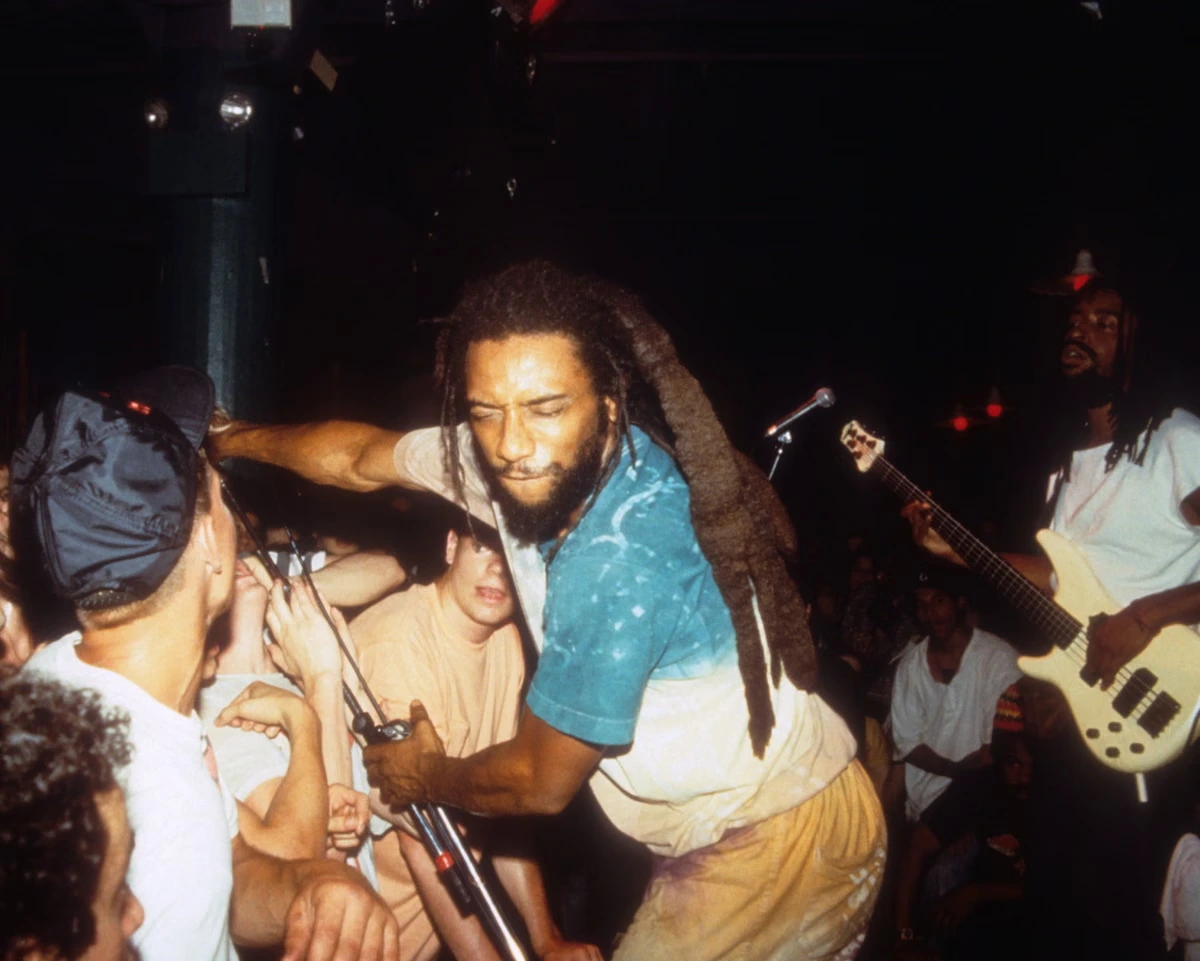
Old punks might not agree on much – who was first, who was fastest, where to file the Faith/Void split LP in their record collection – but for those who saw them in their prime, Bad Brains were, unequivocally, the best live band on the planet. YouTube footage bears this out: frontman HR, born Paul D Hudson, is equal parts straining sinew and raw electricity as he bucks and contorts, punctuating rapid-fire snarls and otherworldly croons with impeccably timed backflips. The band surge around him, forging blisteringly fast punk informed by everything from the Damned and Dead Boys to P-Funk, Stevie Wonder and Chick Corea’s Return to Forever.
Young, black and fuelled by an ideology that united the 1930s self-help mantras of Napoleon Hill with Rastafari, they were outliers in the already outre 70s punk scene. But while Bad Brains helped change the face of American punk as it morphed into hardcore in the early 80s, and inspired artists as diverse as Rage Against the Machine, Deftones, Lil Jon, the Roots and Beastie Boys, defeat was never far from glory as they balanced feted live performances and a scintillating run of records with an excruciating capacity for self-sabotage.
The band’s roots thread back to Central High, a school in Maryland where middle-class military kids HR and his younger brother Earl (drums) met Dr Know (AKA Gary Wayne Miller, guitar) and Darryl Jenifer (bass). Jenifer hailed from Washington DC’s south-east projects. “We had an art teacher that would let us bring in records,” he says. “So you’re making papier-mache, or whatever the fuck, and our clique of musicians met by bringing in things like Billy Cobham’s Spectrum rather than Earth, Wind & Fire.”
The quartet, along with Jenifer’s close friend Sid McCray, began making music, rehearsing in a friend’s house when his mother was out playing bingo. “We were very influenced by all kinds of music,” says Miller. “White, black, rock’n’roll, funk – all the flavours, just like Baskin-Robbins.” Jenifer sums things up more pithily: “My female cousins would say, ‘Darryl listens to white boy music that you can’t dance to.’”
The group initially aspired to the jazz-fusion of Return to Forever and the Mahavishnu Orchestra, although Jenifer suggests this era was little more than adolescent daydreaming. “We called ourselves Mind Power, but we never played a show, and we only had one song. It was the delusional teenage phase: it never was serious, it never was real.”
Things got real, though, when McCray discovered punk, introducing the band to Sex Pistols, Dead Boys and Ramones. “I just remember listening to the music and feeling liberated,” says Jenifer. “Like, damn, I can make some shit like that.”
Mind Power was rechristened Bad Brains, and HR inherited the mic from McCray. “Our first poster said: ‘Bad Brains, the greatest punk rock band in the world’,” laughs Jenifer. While easily chalked up to youthful braggadocio, this radical self-belief was largely the product of the band’s adherence to PMA – positive mental attitude – as a guiding credo.
“My father would say, ‘Why do you want to be a musician? Be a doctor or a lawyer or something,’” says HR from his Texas home. “He told me to read a book, so I read Think and Grow Rich.” This was by Hill, the personal motivation guru. “I decided to use PMA as a formula, as a vehicle in my music, and to try to use it to help guide me through what I was going through.” Dabbling with hard drugs, working a dead-end security job and on the brink of fatherhood, it’s perhaps no surprise that PMA seemed like a lifeline for HR, but his interest was shared by the rest of the band. “We wanted to have a purpose and a message,” says Jenifer. “It wasn’t like being in a band – it was a mission.”
This sense of focus was apparent at the band’s first studio session, when they entered Don Zientara’s Inner Ear Studio in 1979 to record a six-track demo, a pivotal moment that has now been remastered and released by Trust Records under the title Are You Ready: The First Studio Recording. “They were serious,” says Zientara, speaking from his studio. “The songs were there. The energy was there – tons of energy! – and you hear that coming through. At the time, I didn’t have a chance to think about how good they were. They came, they played, they packed up. It was so quick. It was like, did I record these guys?!”
After another demo session, Bad Brains hit their stride with a series of landmark releases: 1980’s brief, brilliant 7-inch Pay to Cum was followed by a self-titled album and then by Rock for Light, produced by Ric Ocasek. These years were turbulent, marked by triumph and tribulation: the band were banned from a number of Washington venues. “They said we incited riots,” says Miller. “The club owners said, ‘You’re making the kids go crazy!’” And, although a scorching 1979 gig with the Damned had led to an invitation to tour the UK, the band tried to enter the country without working papers and were immediately sent back to the US – penniless and with their equipment lost en route.
For all the chaos, this period cemented the band’s legend as a force to be reckoned with. The excitement of their music was matched by a zeal amplified by their burgeoning Rastafari beliefs. “The intention has always been to excite people and make them exult,” says Jenifer. “We’re not performing a riff or trying to nail a show. We’re giving the crowd the vibration to destroy Babylon. This music is the spearhead – that’s what we go on stage with. If we didn’t have that revolutionary spirit, we’d probably feel stupid playing the shit that we play.” Miller, more succinct, agrees: “We’re not lost in the moment,” he says. “We are the moment.”
These sentiments are echoed by many who saw Bad Brains perform. “My friend Bruce and the guys in Autistic Behavior kept telling me, ‘Once you see Bad Brains, your life will change,’” says author and educator Nancy Barile. “They were right.” Barile first saw the band play in Philadelphia in 1982 and had a “physical and visceral” response. “Every time I saw Bad Brains in the early 80s, the audience reaction was insane,” she says. “There’s only a handful of bands I’ve seen get that kind of unrestrained – and totally pure – response and Bad Brains lead the pack. It was chaotic but hypnotic. It was clear that we, the audience, wanted – actually needed – to be participatory in the performance.”
Photographer and artist Glen E Friedman concurs. “The first time I saw Bad Brains was just after these early demos were recorded,” he says. “I was in high school. In all honesty, I had never seen anything or heard anything like them. They were incredible in so many ways.”
The band split for the first time after the release of Rock for Light, with HR wary of major label interest and growing tensions within the band due to his and Earl’s increasing fondness for all-reggae sets. There were also abusive, homophobic clashes with members of the hardcore scene’s gay community – notably with Texas punks Big Boys, whose frontman was gay. The former Hüsker Dü frontman Bob Mould has also recalled incidences where his band were subject to homophobia by Bad Brains. And then there was the roundly condemned (and subsequently disowned) 1989 song Don’t Blow Bubbles – perceived to be anti-gay – which continues to cast a pall over the band’s legacy. Neither Williams nor Jenifer are keen to rake over these incidents, though the latter suggests youthful and misguided zealotry were at play. “I was taught to love all people,” he says now. “I’m no homophobe. I respect life. If you got life, I’m loving you.”
The band reunited for 1986’s blistering I Against I, which saw them expanding their palette into soul, funk and heavy metal, securing the talents of super-producer Ron Saint Germain despite their label’s limited budget. As well as providing the record with oomph, Saint Germain’s technical skill helped overcome certain logistical difficulties – like HR serving time for a marijuana bust.
“I was doing stupid things,” says the singer, “jeopardising my future, and I had to learn the hard way. I was in jail when Sacred Love was recorded. Ron suggested I try to sing some vocals to it over the phone. I was working as a mop, cleaning the floors, and I got in time off on a Sunday. I said, ‘OK, well, I’ll give it a try.’”
From the late 1980s onwards, the band existed in fits and starts. Releases were punctuated by breakups, lineup changes and violent incidents that sank both a series of high-profile gigs with Beastie Boys and a deal with Madonna’s Maverick Records. “Everybody can be a handful,” is how Miller rather plainly sums things up. “When we hit the stage, though, all that stuff doesn’t mean anything because the spirit takes over.”
With Miller still recovering from a severe stroke and cancer, and HR being treated for both Sunct syndrome and schizoaffective disorder, it’s unlikely Bad Brains will perform again. But their deal with Trust Records at least puts their recorded legacy in safe hands – a legacy the band are very much aware of. “When we first started, we knew it was something unique and not what people expected,” says Miller. “It was like, ‘Who’re these brothers playing some rock’n’roll?’ But what they should’ve done was go to the history of rock’n’roll. It’s all Muddy Waters and them guys, not Elvis Presley.”